

Peking University and Zhejiang University team realizes high-dimensional quantum entanglement networks
The quantum network aims to transmit, store and process quantum information in a mesh of quantum nodes coherently connected through quantum channels, surpassing the capabilities of the classical Internet. It has many promising applications such as quantum key distribution (QKD) for secure communications, higher precision clock synchronization, distributed quantum metrology and distributed quantum computing. The key to upgrading the current QKD network is to realize an entanglement network capable of robustly sharing complex entangled states among a large number of remote quantum nodes.
Realizing large-scale and practical quantum entanglement networks remains experimentally challenging. It requires scalable quantum hardware, techniques, and architectures to distribute entangled states among a large number of quantum nodes via high-capacity quantum channels. Quantum photonic integrated circuits are emerging hardware systems for quantum information processing and communication. To date, point-to-point QKD and entanglement distribution have been demonstrated in single-chip-to-single-chip systems utilizing integrated photonic chips, and single microwave resonators have been used as photonic sources for QKD and networking. Fully integrated quantum nodes in networks require full-spectrum monolithic integrated devices for encoding, decoding, multiplexing, manipulating, and detecting optical quantum states. Compared with single-chip or single-chip-to- single-chip quantum experiments, realizing multi-chip quantum networks remains challenging because it requires not only monolithic integration of different devices, but also high quantum indivisibility between the different chips to realize scalable quantum networks.
Meanwhile, practical quantum networks require high-capacity and noise-resistant entanglement transmission. It is well known that multidimensional quantum systems are one of the excellent candidates, but they are susceptible to environmental perturbations when traversing complex media such as multimode fiber (MMF) or air scattering channels. As a result, state perturbation and entanglement degradation inevitably occur.
Recently, a collaborative team from Peking University, Zhejiang University, Institute of Microelectronics of the Chinese Academy of Sciences, Chinese University of Hong Kong, and Hong Kong University of Science and Technology has realized a high-dimensional quantum entanglement network between integrated optical quantum chips. This quantum network chip is fabricated on silicon nanophotonic quantum circuits using large-scale manufacturable technology, three pairs of multidimensional entangled photons are generated on a server chip and coherently distributed over three quantum node chips via few-mode fiber (FMF).

"Multichip multidimensional quantum networks with entanglement retrievability". Eddie Zheng, Ph.D. student, class of 2019, and Chonghao Zhai, Ph.D. student, class of 2021, at the School of Physics, Peking University, and Dr. Dajian Liu at the School of Optoelectronic Science and Engineering/Hangzhou International Science and Technology Center, Zhejiang University, are co-first authors, and Prof. Daoyin Dai at Zhejiang University and Researcher Jianwei Wang at Peking University are co-corresponding authors. Key collaborators also include: researcher Yan Yang, senior engineer Bo Tang, and Zhihua Li from the Institute of Microelectronics, Chinese Academy of Sciences (IMEC); professors Yan Li and Qihuang Gong from Peking University; professor Hon Ki Tsang from the Chinese University of Hong Kong; and doctoral students Jun Mao, Xiao-Jiong Chen, Tian-Xiang Dai, Jie-Shan Huang, Jie-Ming Bao, and Zhaorong Fu from the School of Physics of Peking University, as well as collaborators from the Chinese University of Hong Kong and the Hong Kong University of Science and Technology.
Specifically, the team developed a quantum entanglement retrieval (QER) method that overcomes non-unitary mode perturbations and entanglement degradation to efficiently recover multi-dimensional entangled states distributed on a multi-chip network. The network is realized by hybrid coding and multiplexing the wavelengths, paths, modes and polarization states of photons.

Multi-chip multidimensional entangled network architecture. (A) Diagram of a fully connected entangled network. It consists of a central server chip, n quantum node chips (vertices), n multimode quantum channels (red edges) and quantum correlations (gray edges). All node chips can be fully connected by sharing n(n - 1)/2 pairs of d-dimensionally entangled photons of different wavelengths initially generated on the server chip. Each multimode channel carries n - 1 wavelength-multiplexed single photons that are received and processed on a single node chip. In the experiment, the team built a prototype entangled network with n = 3 and d = 4. (B) Hybrid coding and multiplexing of entangled photons. The entangled photons are wavelength demultiplexed from a broadband light source and then re-multiplexed for entanglement distribution via MMFs between node chips. At each wavelength, d-dimensional quantum states are path-encoded on the chip and coherently converted to mixed-polarized mode-coded states in the fiber.

Integrated silicon photonic quantum network chip.
The 200-mm wafer shown above contains at least 27 identical quantum network chips. The experimental team demonstrated on a small scale the first multichip multidimensional entangled network, with three node chips and a server chip connected by three FMFs.
To realize the entangled network architecture, hybrid multiplexing devices were integrated on a single chip. The network chip allows wavelength multiplexing and demultiplexing of single photons; generation, manipulation, and measurement of path-encoded multidimensional entangled states; and coherent conversion to mixed-polarized-mode-encoded states in the FMF. To achieve scalability, the chip requires wide spectral and modal bandwidths, large fabrication tolerances, and high uniformity across the wafer.
Despite the huge information capacity of MMFs, light propagating in these complex media undergoes troublesome attenuation, leading to mode scrambling and entanglement degradation. In experiments and most practical systems, the transmission matrix of the channel (including path-to-mode conversion and chip-to-fiber interfaces in this study) is usually garbled. This is caused by unavoidable mode loss and crosstalk in MMFs due to fiber bending, twisting, or stretching, as well as mode mismatch at the interface. Therefore, the team implemented a QER method to actively retrieve multidimensional entanglement from any complex scattering process. With an all-optical implementation of QER, the network can self-train its controllable chips (nodes and servers) to retrieve multidimensional entanglement without the need to reconstruct the channel matrix and matrix processing.
QER consists of two phases: the classical channel descrambling (CCU) algorithm and the quantum amplitude balance (QAB) strategy.

Multidimensional entanglement is retrieved in a multimode chip-fiber-chip system.
The team then measures the stability of the whole system by monitoring the crosstalk matrix over a long period of time. The occurrence of any state rotation, either on the chip or on the FMFs or their interfaces, can be monitored by this measurement method. The results show that it observed fluctuations below ±2.5% over 24 hours, indicating that the multidimensional chip-fiber-chip quantum system is well stabilized.
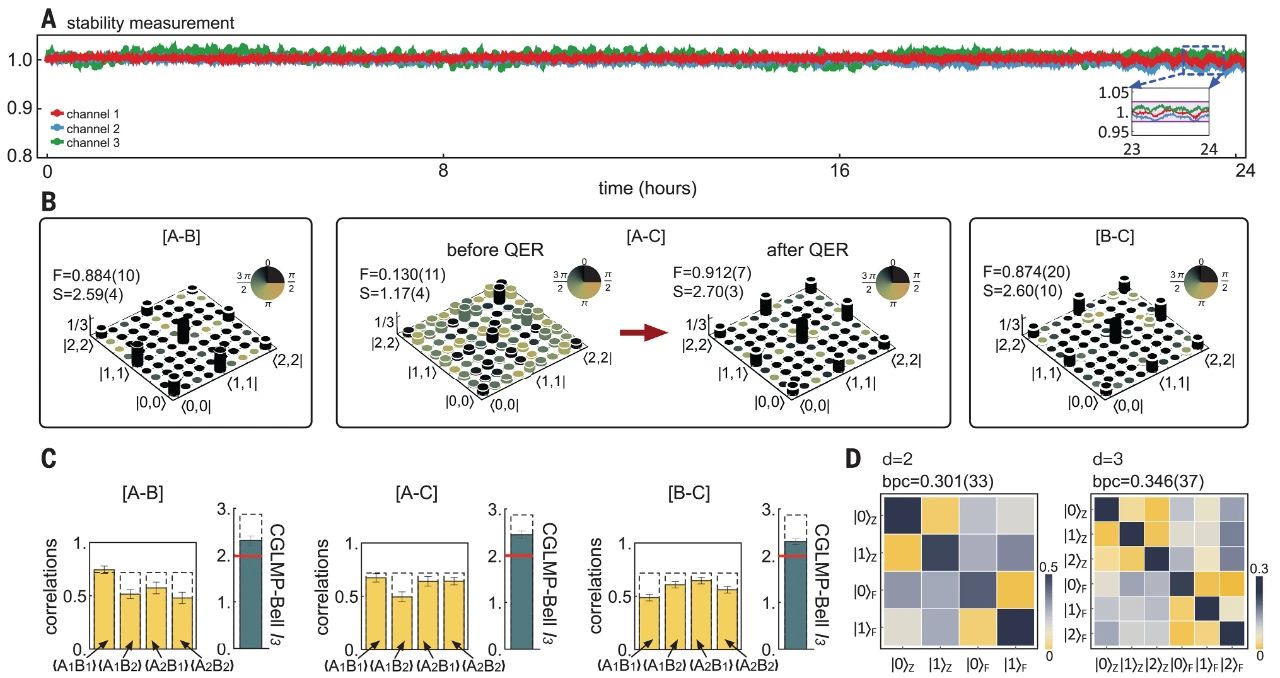
Experimental verification of multidimensional entanglement distribution across multiple silicon chips.
In this experiment, the team demonstrated a retrievable multi-chip multidimensional quantum entanglement network using silicon photonic hybrid multiplexing. All spectra of the hybrid coding and multiplexing devices are monolithically integrated on a chip, providing one of the most sophisticated integrated quantum photonic devices in terms of circuit complexity and functionality.
The scalability of the network architecture, integrated quantum devices, MMF channels and entanglement retrieval techniques has been demonstrated and validated. In future real-world long-distance quantum networks, the environmental noise that causes mode crosstalk and phase drift in MMFs can be all-optical corrected in real time by using fast switching and detection of light in silicon. This work points to the practical realization of large-scale chip-based quantum entanglement networks for quantum information processing and communication.
The above research work has been supported by the National Natural Science Foundation of China, the National Key Research and Development Program, the Beijing Municipal Natural Science Foundation, the R&D Program for Key Areas of Guangdong Province, as well as the State Key Laboratory of Artificial Microstructures and Mesoscopic Physics of Peking University, the Nano-Opto-electronics Frontier Science Center, the Yangtze River Delta Institute of Optoelectronics Science and Research of Peking University, the Hefei National Laboratory of Quantum, and the National Key Laboratory of Extreme Optical Technology and Instruments of Zhejiang University Strong support.


