

Finally, Honeywell creates topological quantum states
On May 9, Quantinuum, a subsidiary of Honeywell, unveiled its second generation quantum computer and used it to create a long-sought mystery particle, the non-abelian arbitrary, taking a key step toward building a fault-tolerant quantum computer.
People have long searched for particles with unusual properties called "arbitrons" as potential building blocks for advanced quantum computers.
Forty years ago, Frank Wilczek was considering a strange type of particle that could only live in a flat universe. If he put pen to paper and performed calculations, these then-theoretical particles had an extraordinary memory of their past, one that was too thoroughly woven into the fabric of reality for any disturbance to erase.
Over the past three decades, researchers have spent millions of dollars trying to capture and tame these particle-like objects, which have a mysterious name: non-Abelian anyon.
Now, this landmark experiment has finally succeeded.
Using Quantinuum's newly launched next-generation H2 processor, scientists have synthesized and manipulated non-Abelian anyons in a new phase of quantum matter.
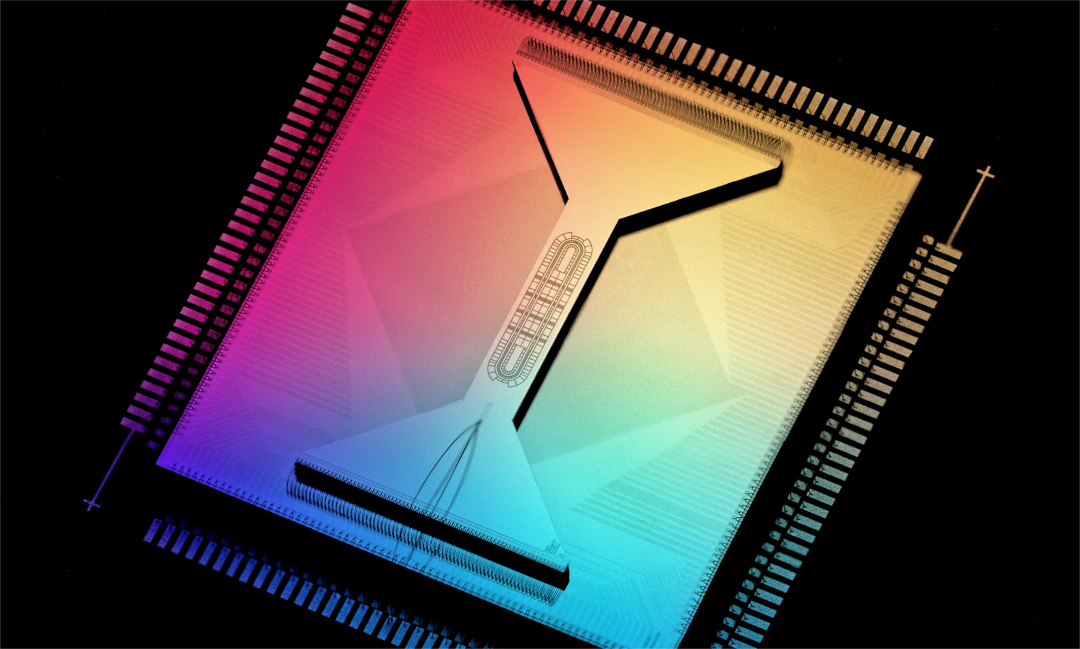
Researchers used Quantinuum's new H2 processor to simulate a new state of matter in which non-abelian arbitrons can be created and manipulated.
This achievement demonstrates the growing power of quantum devices while providing a potential "glimpse" into the future of computing: by maintaining a nearly indestructible record of their journey through space and time, non-abelian arbitrons could provide the most promising platform for building fault-tolerant quantum computers.

The new system model H2 has 32 fully connected high-fidelity quantum bits, and a completely new architecture with a new ion trap whose elliptical shape resembles a race track. quantinuum demonstrates the capabilities of H2 by showing 32 quantum bits in the GHZ state (which is a non-classical state), and that all 32 quantum bits are globally entangled. This is the largest on record and the highest performance quantum computer ever built.
The track design of the system model H2 implements full connectivity between quantum bits, which means that each quantum bit in H2 can be directly pairwise entangled with any other quantum bit in the system. Doing so reduces overall errors in the algorithm; in the long run, this opens up more opportunities for new, more efficient error-correcting codes.
The core team for this development is based in Munich and is led by Dr. Henrik Dreyer.
The H2 design is a strong step toward demonstrating the scalability potential of ion trap devices. It extends the ion trap in a quantum charge-coupled device (QCCD) architecture: demonstrating the ability to scale the number of quantum bits while maintaining performance, paving the way for further scaling in subsequent generations.
The H2 is designed to be upgraded over its product lifecycle, which means that both the number of quantum bits and the quality of quantum bits will be improved. Meanwhile, H2 launched with a quantum volume of 65,536 - surpassing the world record announced using H1-1 in February of this year.
"With our second-generation system, we are entering a new phase of quantum computing. h2 highlights the opportunity to achieve valuable results that are only possible in a quantum computer. the development of the h2 processor is also a key step toward universal fault-tolerant quantum computing." said Tony Uttley, Quantinuum founder, president and chief operating officer.
H2 is now accessible through Quantinuum's cloud and will be available through Microsoft Azure Quantum beginning in June. In addition, H2's noise-informed simulator will accelerate quantum computing simulation workflows through NVIDIA's optimization library and tools, the cuQuantum SDK.
Topological quantum computing has been a long and winding road over the past few decades.

Frank Wilczek, a physicist at the Massachusetts Institute of Technology
In 1982, Wilczek helped open physicists' minds to the variety of particles that might exist in two dimensions. He studied the results of restricting quantum laws to a hypothetical, perfectly flat universe and found that it would contain strange particles with fractional spin and charge; in addition, exchanging other indistinguishable particles could change their ways - something impossible for their three-dimensional counterparts. wilczek named these Two-dimensional particles are named arbitrons (Anyon) because they seem to be able to do almost anything.
Unfortunately, Wilczek focused on the simplest "nonlinear" arbitrons: particles that change in subtle ways that are not directly detectable when they are exchanged.
He did not explore the crazier option: non-abelian arbitrators - particles that share memory. Swapping the positions of two non-abelian arbitrons produces a directly observable effect. It switches the state of their shared wave function (a quantity that describes the quantum nature of the system). For example, if you stumble upon two identical non-abelian arbitrators, by measuring the states they are in, you can tell if they have been in those positions all along, or if they have crossed paths - something that other particles are far from being able to do.
In 1991, two physicists determined these states. They predicted that when subjected to a strong enough magnetic field and a cold enough temperature, electrons stuck to a surface would spin together in just the right way to form non-abelian arbitrators. Arbitrons will not be elementary particles (which our three-dimensional world forbids), but "quasiparticles". Quasiparticles have precise positions and behaviors, just as a collection of water molecules produces waves and vortices.
In 1997, Caltech theorist Alexei Kitaev pointed out that such quasiparticles could provide the perfect foundation for quantum computers. Physicists have long "salivated" over the possibility of computing with the quantum world, which has a performance unattainable by classical computers and their binary bits. However, quantum bits (the atom-like building blocks of quantum computers) are fragile: their wave functions can collapse under the lightest touch, erasing their memory and their ability to perform quantum computations. This fragility makes the ambition of controlling quantum bits for long enough to complete lengthy computations unattainable.
Kitaev realized that the shared memory of non-abelian arbitrators could serve as an ideal quantum bit. First, it is malleable: scientists can change the state of a quantum bit by "braiding" the position of an arbitrary (flipping a 0 to a 1).

Weaving quantum information. By carefully manipulating the connections between quantum bits, researchers are able to weave objects together with their past memories.
We can also read out the state of that quantum bit. For example, when the simplest non-abelian arbitrators are brought together and "fused," another quasiparticle is emitted only after they have been woven together. This quasiparticle serves as a physical record of their interlaced journey through space and time.
Crucially, this memory is also nearly indestructible. As long as any quasiparticle remains far away, no destruction of any individual particle will change the state that the pair is in. In this way, their collective memory can be effectively isolated from the noise of the universe - which would be the perfect place to store information.
Kitaev's proposal is known as topological quantum computing. Most researchers now believe that they are the future of quantum computing. For example, researchers at Microsoft Corp. are trying to control the direct formation of non-abelian arbitrators from electrons. The company has invested millions of dollars in building tiny wires with the expectation that at these low temperatures, electrons will naturally cluster to form arbitrons, which in turn can be woven into reliable quantum bits.
However, after a decade of work, these researchers still could not prove that their approach would work. 2018. There was a team statement that the simplest type of non-abelian quasiparticle, the "Majorana zero mode," had been detected, but this was then retracted in 2021 with the same high profile.
A similar effort to turn electrons into non-abelian arbitrators has stalled. Bob Willett at Nokia Bell Labs tried to condense electrons in GaAs; however, the final data were extremely confusing, with ultracold temperatures, ultrapure materials, and ultra-strong magnetic fields making the experiment difficult to reproduce.
Suffice it to say, nothing was observed for a long time.
Now, quantum processors are changing the search for arbitrons. This is because the quanta inside the processor are abstractions of particles (although their physical properties vary by experimental route, they can all be imagined as particles spinning around an axis). However, quantum bits are real matter, so quantum processors are becoming a playground for topological experiments.
Last summer, there was an experimental team that tested their theory on Quantinuum's H1 capture ion processor: they made non-abelian ring ciphers and wove together their non-abelian defects. They tried the non-abelian phase, but with only 20 quantum bits, they couldn't get there.
This time, Quantinuum's second-generation device, H2, has up to 32 quantum bits, but the team managed to create the simplest non-abelian phase on 27 of them.
This experiment marks the first unquestionable detection of a non-abelian phase of matter - an absolutely significant milestone.
Quantinuum's Munich, Germany-based physicist Henrik Dreyer's team has successfully braided three pairs of non-abelian arbitrators so that their trajectories through space and time form a pattern known as a Borromean ring, the first braiding of non-abelian arbitrators. The three Borromean rings are inseparable when together, but if one is cut off, the other two will fall apart.
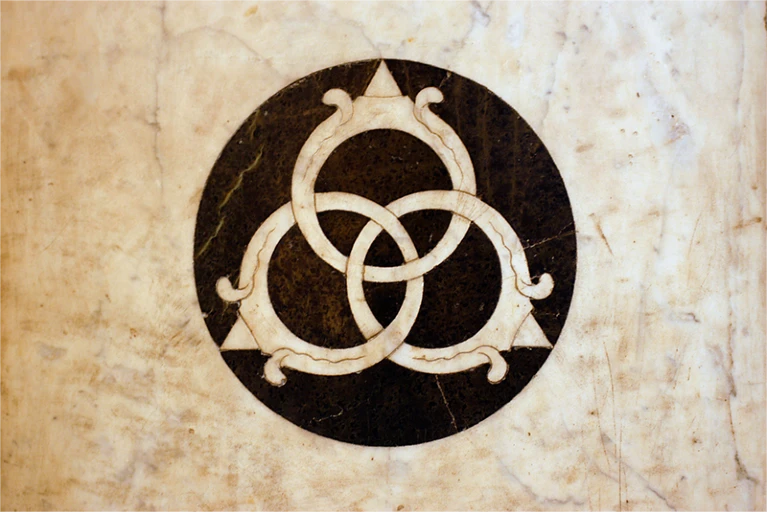
Borromean rings depicted in a church in Florence, Italy, the coat of arms of the noble Borromeo family of Italy.

In this experiment, non-Abelian arbitrators were woven. Their Borromean rings exist only as information within a quantum computer. But their connectivity properties can help make quantum computers less error-prone, or more "fault-tolerant.
Quantinuum ion trap quantum computers have an advantage over most other types of quantum bits: the ions in their traps can be moved around and made to interact with each other, which is how quantum computers perform their calculations.
Physicists have used this flexibility to create an extraordinarily complex form of quantum entanglement in which all 32 ions share the same quantum state. By designing these interactions, they created a virtual entangled lattice - with a structure of 27 quantum bits of kagome (a pattern used in Japanese basket weaving that resembles the repeated overlap of a six-pointed star; when folded, it forms a doughnut shape).
The entangled state represents the lowest energy state of the virtual two-dimensional universe (a state that essentially contains no particles at all). However, by further manipulation, the kagome is placed in an excited state: this corresponds to the appearance of particles which should have the properties of non-abelian arbitrators.
In order to prove that these excited states are non-abelian arbitrators, the research team performed a series of tests. The most convincing tests included moving the excited states to create virtual Borromean rings - the emergence of the mode was confirmed by measurements of the ion states during and after the operation.
No two particles were brought around each other, but they were all linked together," said Ashvin Vishwanath, a theoretical physicist at Harvard University and co-author of the paper. It's really an amazing state of matter that we don't have a very clear picture of in any other setup."
Despite the impressive results, the Quantinuum machine did not actually create non-abelian arbitrators, but only simulated some of their properties. Still, the authors say that the behavior of these particles satisfies the definition; and for practical purposes, they can still constitute quantum computing.
Creating a topological phase on a quantum processor is like making the world's smallest ice cube by stacking dozens of water molecules.
The most exciting aspect of these experiments is what they mean for quantum computing: the researchers have finally shown that 26 years after Kitaev's original proposal, they can make the necessary ingredients for topological quantum computing. Now, they just need to figure out how to actually put them to work.
The next milestone will be true error correction.
"Fault-tolerant quantum computing is our ultimate goal. Our world leadership in quantum computing is constantly being demonstrated and proven by real progress. And the creation and manipulation of non-abelian arbitrators to create topological quantum bits is another example." Ilyas Khan, founder and chief product officer and former chief executive officer of Quantinuum, said.
"This could well be a transistor moment for the quantum computing industry - the fact that we are using quantum computers as machine tools to build topological quantum bits is an important step toward fault-tolerant quantum computing, a fact that further demonstrates our long-held belief that quantum systems are best explored and created by other quantum systems to explore and create."
"This is exactly what Feynman anticipated in his now famous remarks, which are often cited as the basis for quantum computing."
Dr. Rajeeb (Raj) Hazra, CEO of Quantinuum, also said, "Today marks a turning point for those who believe that a quantum computer capable of advancing human knowledge and science is still a long way off. A world-leading team of scientists has used Quantinuum's H2 quantum computer to achieve what was previously impossible."
"H2 provides a breakthrough moment for Quantinuum." He added: "Our second-generation quantum computer, powered by the H2 quantum processor and associated software, offers the best performance in the industry today, while laying the foundation for significantly accelerating the development of fault-tolerant quantum computing."
Link to original article:
https://arxiv.org/pdf/2305.03766.pdf
Reference links:
[1] https://www.quantinuum.com/hardware/h2
[2]https://www.eenewseurope.com/en/quantinuum-claims-worlds-most-complex-quantum-computer-with-h2/
[3] https://www.quantinuum.com/news/for-the-first-time-ever-quantinuums-new-h2-quantum-computer-has-created-non-abelian-topological -quantum-matter-and-braided-its-anyons
[4]https://www.sdxcentral.com/articles/news/quantinuum-doubles-down-on-trapped-


