

Novel quantum phase transition First quantum entanglement of thousands of atoms discovered
Whether magnets or superconductors: materials are known for their various properties; however, these properties may change spontaneously under extreme conditions. Researchers at the Technical University of Dresden (TUD) and the Technical University of Munich (TUM) have discovered a completely new type of phase transition - they show quantum entanglement phenomena involving many atoms, which had previously been observed only in the domain of a few atoms.
The relevant research results were published on August 31 in the journal Nature under the title "Emergence of mesoscale quantum phase transitions in ferromagnets" [1].

01Quantum phase transitions and entanglement
If we look at water, we can easily observe the properties of a substance that changes spontaneously: at 100 degrees Celsius, it evaporates into a gas; at 0 degrees Celsius, it freezes into ice. In both cases, the formation of these new states of matter is the result of a phase change: the water molecules rearrange themselves, thus changing the properties of the matter. The appearance of properties such as magnetism or superconductivity is the result of a phase change of electrons in the crystal. For phase transitions at temperatures close to absolute zero (-273.15 degrees Celsius), quantum mechanical effects such as entanglement come into play, hence the 'quantum phase transition.' explains Christian Pfleiderer, professor of topology at TUM: "Despite more than 30 years of extensive research devoted to phase transitions in quantum materials, we previously thought that the phenomenon of entanglement only works at the microscopic scale, where it involves only a few atoms at a time."
Quantum entanglement is one of the most surprising phenomena in physics, where entangled quantum particles exist in a shared superposition of states that allow normally mutually exclusive properties (e.g., black and white) to occur simultaneously. Normally, the laws of quantum mechanics apply only to microscopic particles. Now, the research group at TUD, TUM has succeeded in observing quantum entanglement effects on a much larger scale, i.e., the entanglement of thousands (many thousands of) atoms.
02Compound LiHoF4: Discovery of a new phase transition
For this experiment, they chose the well-known compound lithium holmium fluoride (LiHoF4). At very low temperatures, LiHoF4 acts like a ferromagnet, with all the magnetic moments spontaneously pointing in the same direction. If you then apply a magnetic field exactly perpendicular to the preferred magnetic direction, the magnetic moments will change direction, which is called a "fluctuation". The higher the magnetic field strength, the stronger these fluctuations become; until finally, the ferromagnetism disappears completely in a quantum phase transition. This leads to the entanglement of adjacent magnetic moments." If you hold a sample of LiHoF4 up to a very strong magnet, it will suddenly stop being spontaneously magnetic." Matthias Vojta, chair of theoretical solid state physics at TUD, concludes, "It's been 25 years since scientists discovered this phenomenon."
What is new is what happens when you change the direction of the magnetic field (φ.) Pfleiderer explains, "We found that the quantum phase transition continues to occur, whereas previously it was thought that even the smallest tilt of the magnetic field would immediately suppress it. Under these conditions, however, it is not individual magnetic moments that undergo these quantum phase transitions, but broad magnetic regions - the so-called 'ferromagnetic domains'. These domains constitute entire islands (islands) of magnetic moments pointing in the same direction."
This means that for LiHoF4, physicists have discovered a completely new phase transition - a mesoscale quantum critical point - that derives from the textbook example of the microscopic ferromagnetic TF-QCP.
Matthias Vojta, TUD Chair in Theoretical Solid State Physics, commented, "Our quantum 'cat' now has a new skin in the game, as we have discovered a new quantum phase transition in LiHoF4 that was not known to exist before. "

crystal unit of LiHoF4

spherical sample used in the experimental study to ensure uniformity of the demagnetization field throughout the sample volume.
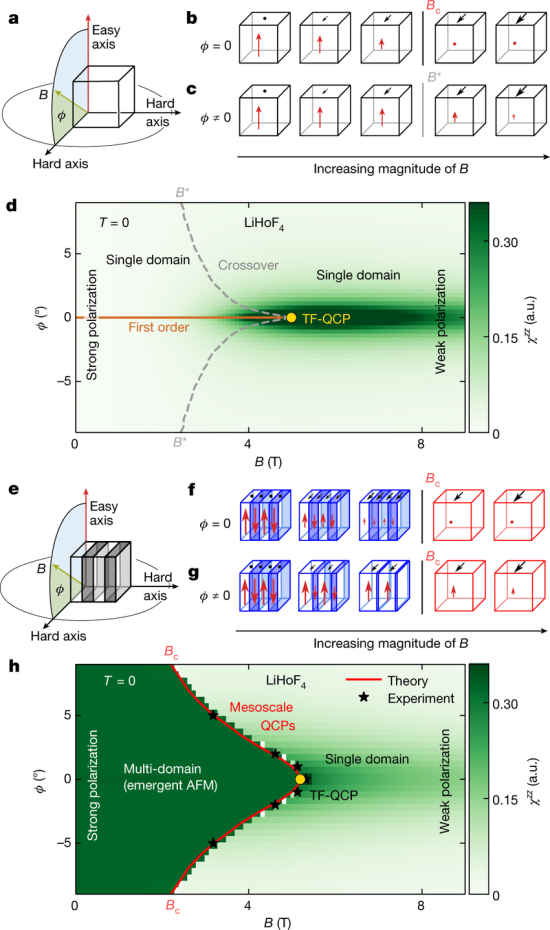
The zero-temperature phase diagram of the microscopic transverse field Ising model and the domain model of LiHoF4 as a function of field strength B and field direction φ. The cube is used to describe the magnetization components along the easy magnetic axis (red) and the hard magnetic axis (black), as defined in Figs. a and e. The field direction includes the angle φ with respect to the hard magnetic axis, i.e., the transverse field condition corresponds to φ = 0. b-d, purely microscopic scheme, without considering the formation of stray fields and magnetic texture (magnetic texture). At φ = 0, the first-order phase transition terminates in the TF-QCP. f-h, the same microscopic model as considered in the a-d diagrams, but also taking into account the effect of stray fields and the formation of the accompanying multi-domain states, i.e., the emergence of antiferromagnetism (AFM). An explicit phase transition separates the low field (strongly polarized) multi-domain state (emergent AFM) from the high field single domain (weakly polarized) state. As a function of the magnetic field with φ ≠ 0, a row of mesoscale quantum critical points (QCP) is formed. This transition coincides with the microscopic TF-QCP at φ=0.
03Providing the basis for applications: quantum sensing, quantum computing
"We have discovered a completely new kind of quantum phase transition. Where entanglement occurs on the scale of thousands of atoms, not just in the microscopic world of just a few atoms. "If you imagine the magnetic domain as a black and white pattern, the new phase transition causes the white or black region to become infinitely small, i.e., a quantum pattern is formed and then dissolves completely," Vojta explained. "A newly developed theoretical model successfully explains the data obtained from the experiment. "For our analysis, we generalize the existing microscopic model and also take into account the feedback of large ferromagnetic domains on the microscopic properties." Elaborates current PhD student Heike Eisenlohr.
The discovery of the new quantum phase transition is an important foundation and general reference framework for studying quantum phenomena in materials as well as for new applications. says Vojta: "Quantum entanglement is used in technologies such as quantum sensors and quantum computers, as well as for other applications." Pfleiderer added, "Although our work is in the field of fundamental research, however, if the properties of the material are used in a controlled manner, it can have a direct impact on the development of practical applications."
The research was funded by the German federal and state governments' strategy of excellence within the Cluster of Excellence for Complexity and Topology of Quantum Matter (ct.qmat) and the Munich Center for Quantum Science and Technology Cluster of Excellence (MCQST). In addition, this work was supported by the European Research Council (ERC) Advanced Grant ExQuiSid and the Collaborative Research Center (SFB) of the German Research Foundation (DFG) and TRR80 [2].
Reference link:
[1]https://www.nature.com/articles/s41586-022-04995-5
[2]https://www.sciencedaily.com/releases/2022/09/220902103303.htm


