

2026 Global Quantum Computing Industry Development Outlook: Unlocking Engineering Metamorphosis and Future Computing Power Revolution
At the critical turning point where quantum technology transitions from laboratory research to industrial application, an authoritative and comprehensive industry report can always illuminate the path for practitioners, investors, and researchers. The 2026 Global Quantum Computing Industry Development Outlook, jointly released by ICV TA&K and QUANTUMCHINA, is precisely such a landmark guide covering technological breakthroughs, industrial patterns, policy environments, and investment trends. Hailed as the "annual benchmark" for the quantum field, it is a must-read for anyone concerned with cutting-edge technology.

I. Core Value of the Report: Why It’s Indispensable
As a professional report focusing on the quantum computing industry, its value lies in three key dimensions:
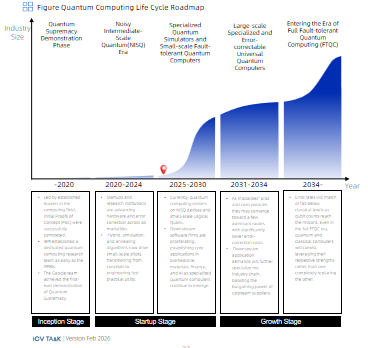
- Dual Strengths of Timeliness and Forward-Looking Insight: Built on critical global quantum industry progress in 2025, it accurately predicts development trends through 2026 and the next decade, clearly mapping the technical path and industrial milestones in the transition from the NISQ era to Fault-Tolerant Quantum Computing (FTQC).
- End-to-End Coverage with No Blind Spots: From upstream core equipment (dilution refrigerators, quantum chips) and midstream hardware systems (superconducting, trapped-ion, neutral atom, and other technical routes) to downstream software algorithms, cloud platforms, and industry applications, it constructs a complete industrial map. It deciphers both technical details and commercial logic.
- Global Perspective Combined with Localized Insights: Simultaneously presenting policy layouts and competitive dynamics of major economies including China, the United States, Europe, and Japan, it interprets global capital flows while highlighting Chinese enterprises’ breakthroughs in quantum independent control. It provides targeted references for readers with diverse needs.
II. Highlighted Content Preview
1. Technological Evolution: From "Qubit Count Competition" to "Logical Quality Race"
2025 witnessed a qualitative leap in quantum computing hardware. The report details key breakthroughs across major technical routes:
- Superconducting Route: IBM’s Nighthawk processor adopts a new Square Lattice architecture; Google’s Willow chip achieves exponential suppression of logical error rates.
- Trapped-Ion Route: Quantinuum’s Helios system realizes high-fidelity control of 98 qubits.
- Neutral Atom Route: Emerging as a "dark horse," QuEra achieves controllable arrays of thousands of atoms; China’s CAS Cold Atom launches a 100+ qubit prototype.
- Software Innovation: Deep integration of AI and quantum error correction, with real-time neural decoding and hybrid compilation optimization bringing FTQC closer to reality.
2. Industrial Pattern: Coexistence of Global Competition and Ecosystem Collaboration
Through the innovative "Quantum Ecosystem Maturity Compass Model," the report categorizes global enterprises into four types: Ecosystem Core Enterprises, Independent Explorers, Ecosystem Followers, and Rising Stars.
- The United States leads technologically with IBM, Google, and IonQ.
- Europe builds a distinctive ecosystem through companies like IQM and Pasqal.
- China achieves full-chain breakthroughs led by China Telecom Quantum Group and QuantumCTek, with the "Tianyan" quantum cloud platform recording over 44 million global visits, demonstrating strong national strength.
3. Application Landing: From R&D Validation to Industrial Piloting
The commercial value of quantum computing is accelerating its release:
- Materials Science: Mitsui and Quantinuum’s joint QIDO platform improves complex molecular simulation accuracy tenfold.
- Biomedicine: Eli Lilly and Creyon Bio leverage quantum data to train AI models, accelerating nucleic acid drug development.
- Finance: HSBC and IBM’s quantum-enhanced model boosts bond trading prediction accuracy by 34%.
- Key Sectors: Quantum-optimized scheduling and quantum-secure communication have launched pilot projects in energy and national defense.
4. Policy and Capital: Global Strategic Layouts and Concentrated Investment
- Policy Support: Major economies prioritize quantum technology as a national strategy— the U.S. upgrades the National Quantum Initiative Act, while China lists quantum technology as a core engine of "New Quality Productive Forces" in the 15th Five-Year Plan.
- Capital Trends: 2025 global quantum computing financing reached $5.395 billion, with the U.S. leading at $4.463 billion; China’s financing stood at $135 million, showing prudent growth focused on practical projects.
5. Future Trends: Toward Large-Scale Industrialization
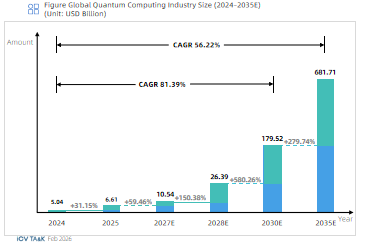
The report predicts that quantum computing will enter a critical phase of full-scale industrialization in 2026. By 2030, the global market size is expected to surge to $179.52 billion, and exceed $681.71 billion by 2035, marking the era of comprehensive commercial prosperity. Key trends include hybrid Quantum-HPC-AI integration, iterative upgrading of fault-tolerant technologies, and deepening of industry-specific applications.
Authoritative Release and Acquisition Method
This report is based on multi-source data verification, in-depth interviews with over 30 global experts, and advanced modeling analysis, integrating the dynamics of more than 20 countries' policies, over 100 core enterprises, and 500+ technological breakthroughs, providing forward-looking and actionable strategic references for the industry.
👉 Download the Full Report Now to unlock panoramic insights into the quantum security industry, technical route comparisons, regional development guides, and application landing toolkits, and seize the strategic opportunities of the next-generation digital security.
📩 For bulk acquisitions, customized analysis, or cooperation inquiries, please contact:
- Email: infer@icvtank.com
- Official Website: https://www.icvtank.com/
- Address: Mississauga, Canada | Singapore


