

2026 Global Quantum Security Industry Development Outlook: Technology Reconstruction and Ecosystem Symbiosis
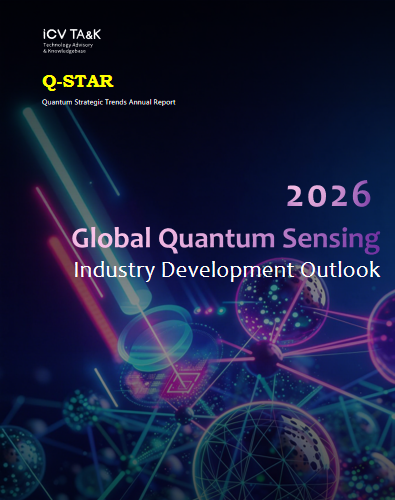 As quantum computing capabilities continue to advance, traditional public-key cryptosystems face systemic risks, and quantum security has evolved from a cutting-edge technology reserve to a core capability ensuring the long-term security of digital infrastructure. Co-released by ICV TA&K and QUANTUMCHINA, the 2026 Global Quantum Security Industry Development Outlook systematically analyzes the technological evolution, industrial landscape, and future pathways of the industry during this critical transitional period from a global perspective, providing an authoritative action guide for policymakers, enterprise decision-makers, and investors.
Core Highlights: A Panoramic Insight from Technological Breakthroughs to Industrial Landing
I. The Industry Enters a New Phase of Systematic Development
In 2026, the global quantum security industry is shifting from "driven by isolated technological breakthroughs" to "jointly driven by institutional arrangements, engineering implementation, and industrial collaboration." Countries worldwide have incorporated quantum security into their national strategies and cybersecurity systems: the United States accelerates the landing of Post-Quantum Cryptography (PQC) standards and the migration of federal systems, the European Union advances a unified standard system and the deployment of quantum communication infrastructure, and China focuses on the integrated development of quantum security and next-generation information infrastructure, forming a global consensus of "policy guidance, standard implementation, and engineering advancement."
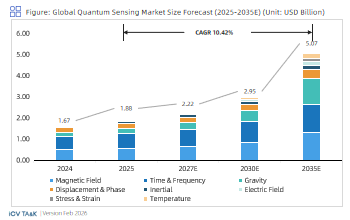
The industry scale continues to expand, with the global market size reaching $2.703 billion in 2025. It is projected to grow to $11.805 billion by 2030 (CAGR 34%) and further exceed $76.795 billion by 2035 (CAGR 45%-46%), becoming a core force reshaping the global digital security architecture.
II. Dual Technical Pathways: Building a "Dual Defense" System for Quantum Security
The report conducts an in-depth analysis of the development status and breakthrough directions of the two core technical pathways in quantum security, presenting a dual defense pattern of "physical mechanisms + mathematical theories":
1. Quantum Key Distribution (QKD): From Laboratory to Large-Scale Deployment
- Technological Breakthroughs: Achieved key milestones such as the optimal key rate for 403-kilometer fiber transmission (2.92 times beyond the repeaterless boundary) and a 1.03 Mbit/s key rate for the 201-kilometer Asynchronous Measurement-Device-Independent (A-MDI) protocol. Space-air-ground integrated communication is advancing steadily, and the stability of quantum communication on mobile platforms has been significantly improved.
- Engineering Progress: Chip-level integration is accelerating. The world's first full-function Quantum Random Number Generation (QRNG) chip measures only 16.6×7.8 mm² and can stably output within the industrial temperature range of -40℃ to 85℃. Quantum repeater technology is moving from principle verification to practical exploration, with hybrid repeater schemes becoming the core direction in the near to medium term.
- Network Deployment: Countries around the world are promoting the construction of backbone networks and metropolitan area networks. The Geneva Quantum Network (262 kilometers) is officially operational, China has achieved large-scale deployment in 40 cities, and the satellite-ground quantum key distribution distance has exceeded 10,000 kilometers, laying the foundation for the global quantum communication network.
2. Post-Quantum Cryptography (PQC): From Standard Formulation to Engineering Migration
- Standard Landing: NIST has selected the HQC algorithm as a supplementary standard for PQC, forming a "main-standby collaborative" system with lattice-based cryptography as the core. China, the European Union, South Korea, and other regions are accelerating the advancement of regional standards, with South Korea establishing its independent algorithm standard through the KpqC competition.
- Engineering Breakthroughs: Hardware-software co-design has become the mainstream implementation approach. SEALSQ has launched the first hardware-embedded PQC security chip, Samsung has integrated PQC hardware into mobile terminals, and side-channel protection and cryptographic agility design have become technical focuses.
- Migration Practice: The world has entered the phase of PQC migration implementation. The U.S. federal system has initiated the inventory and replacement of cryptographic assets, Europe has standardized hybrid key exchange through the ETSI TS 104 015 standard, and China has launched pilot deployments in key fields such as finance and power.
III. Global Landscape: Three Major Technology Blocs and Regional Characteristic Pathways
The report clearly outlines the global quantum security landscape of "tripartite confrontation" among China, the United States, and Europe, with each region forming differentiated development pathways:
- United States: Drives systematic migration through standard implementation, focusing on software ecosystems and protocol integration, and leading global PQC rule-making. Cloud service providers and startups jointly promote engineering deployment.
- China: Focuses on infrastructure construction, advancing the coordinated development of QKD network scale and PQC independent innovation, and forming advantages in space-air-ground integrated communication and domestic quantum chips.
- European Union: Relies on transnational collaboration and regulatory frameworks to promote the construction of cross-border quantum infrastructure such as EuroQCI, focusing on standard interoperability and ethical governance.
- In addition, Canada, Japan, South Korea, India, and other countries are focusing on space quantum communication, precision manufacturing, terminal applications, and national security scenarios respectively, forming a diversified supplement.
IV. Application Landing: From Key Fields to Digital Infrastructure Embedding
Quantum security is penetrating from high-security demand scenarios to all industries. The report focuses on analyzing six core application areas:
- Finance: PQC migration and QKD critical link protection are advancing in parallel. The Monetary Authority of Singapore has launched QKD pilots, and top global payment institutions have achieved 100% PQC compliance.
- Power Grid: Focusing on the security of dispatching instructions and the protection of distributed energy communication, China State Grid has realized 125-kilometer "fiber + quantum" encrypted data transmission in Zhejiang.
- Telecommunications: Operators are leading the commercialization of quantum security services. Orange and Toshiba have launched France's first commercial quantum security network service, and China Telecom has built a national quantum security infrastructure.
- Military and Defense: Integrating into core defense system upgrades, the U.S. Air Force is promoting the testing of quantum network components, and Canada is participating in the quantum technology research for NORAD modernization.
- Government Affairs: Urban-level quantum security platforms support cross-departmental data exchange, and Mianyang, China, has built the first urban quantum metropolitan area network in Southwest China.
- Emerging Scenarios: Accelerating embedding in 6G, Internet of Vehicles (IoV), Low Earth Orbit (LEO) satellite communications, and other frontier fields, with security capabilities integrated into infrastructure design.
V. Industry Ecosystem and Future Outlook
The report evaluates the competitiveness of global mainstream suppliers through the unique Q-EMC (Quantum Ecosystem Maturity Compass) model, identifying four types of core players: Ecosystem Leaders, Independent Innovators, Emerging Stars, and Ecosystem Followers.
Looking to the future, quantum security will present eight major trends: policy and institutional intervention as the fundamental prerequisite for development, the market entering a sustained growth phase, PQC migration focusing on compliance requirements, hybrid cryptography becoming the mainstream configuration of network infrastructure, delivery capability emerging as a core competitive variable, the solidification of the geopolitical landscape into three major technology blocs, the integration of multiple quantum technologies as a long-term trend, and "Quantum+" accelerating penetration with quantum security embedded into digital infrastructure.
Authoritative Release and Acquisition Method
This report is based on multi-source data verification, in-depth interviews with over 30 global experts, and advanced modeling analysis, integrating the dynamics of more than 20 countries' policies, over 100 core enterprises, and 500+ technological breakthroughs, providing forward-looking and actionable strategic references for the industry.
👉 Download the Full Report Now to unlock panoramic insights into the quantum security industry, technical route comparisons, regional development guides, and application landing toolkits, and seize the strategic opportunities of the next-generation digital security.
📩 For bulk acquisitions, customized analysis, or cooperation inquiries, please contact:
- Email: infer@icvtank.com
- Official Website: https://www.icvtank.com/
- Address: Mississauga, Canada | Singapore


