

2026 Global Quantum Security Industry Development Outlook
In 2025, the global quantum security industry reached a pivotal milestone, transitioning from a phase of technological capability building to systematic formation. The core logic of industry development has fundamentally transformed—from being driven by isolated technological breakthroughs to being propelled by a combination of institutional arrangements, engineering implementation, and industrial collaboration.
From a global perspective, major economies have all elevated quantum security to a key component of national strategy and cybersecurity systems:
The United States, following the finalization of its Post-Quantum Cryptography (PQC) standards, is accelerating the migration of federal systems and supporting industrial implementation.
Europe, under a unified strategic framework, is strengthening its standards system while concurrently advancing the deployment of quantum communication infrastructure.
China, guided by national planning, emphasizes the integrated development of quantum security with next-generation information infrastructure.
Other countries—including Canada, Japan, South Korea, and India—are also pursuing deployments centered on critical infrastructure security and advanced communication frameworks.
Although national pathways differ, all exhibit a converging trend of policy guidance, standards implementation, and engineering advancement. The global quantum security industry has entered a phase of institutionalized and systematic progression.
1. Policy and Standardization Advance in Coordination
In 2025, major global economies elevated quantum security to a core issue within national strategies and cybersecurity frameworks. The United States advanced the National Quantum Initiative Reauthorization Act, while the European Union released the "Quantum Europe Strategy." China, in its "15th Five-Year Plan," prioritized quantum technology as a key new economic growth driver.
Standardization efforts are accelerating globally, with a phased progression pattern emerging. The U.S. has completed PQC standards formulation through NIST, while Europe and China continue to refine their standard systems through ETSI and national cryptography regulatory authorities.
2. Technical Architecture Attains Maturity
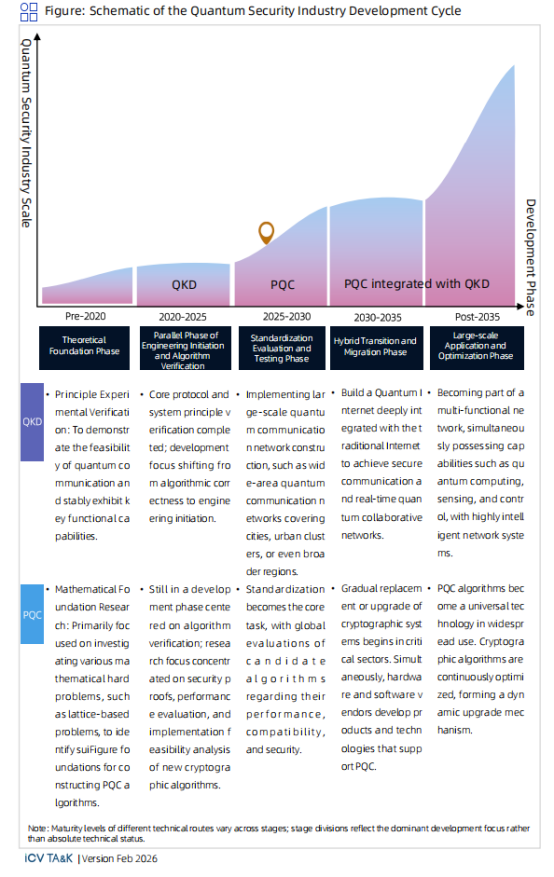
The year 2025 was a pivotal milestone as quantum security technology transitioned from experimental validation to large-scale application. Quantum Key Distribution (QKD) has evolved from point-to-point trials toward networked and service-oriented configurations. Quantum Random Number Generators (QRNG) achieved industrial breakthroughs in chip integration and generation rates. Following core standardization completion, Post-Quantum Cryptography (PQC) is accelerating into the engineering deployment and industrial migration phase.

3. Industrial Chain Synergy Accelerates
The collaboration level within the quantum security industry chain has further enhanced, with industrial development placing greater emphasis on coordinated advancement between core components, system integration, and vertical applications. In the upstream segment, key components such as Single-Photon Detectors (SPDs) and QRNG chips have seen continuous improvements in performance stability and supply capacity. In the midstream segment, system integrators are prioritizing product versatility through modular design and platform-based solutions.

4. Post-Quantum Cryptography Enters Engineering Deployment
As the threats posed by quantum computing to traditional Public Key Infrastructure (PKI) are progressively quantified, PQC is transitioning from algorithmic research into a phase of large-scale application. Cryptographic schemes represented by lattice-based, code-based, and multivariate polynomial frameworks are continuously maturing. PQC has initiated pilot deployments in critical sectors such as government affairs, finance, telecommunications, and energy, becoming the pragmatic technical roadmap for nations to mitigate quantum computing risks.
5. Investment and Financing Trend Toward Rationality
In 2025, investment and financing activities in the global quantum security sector remained active, yet capital allocation demonstrated a marked shift toward rationality. Total investment reached approximately $102 million, a decline compared to 2024, reflecting a market transition from broad, early-stage positioning toward a phase that prioritizes technological maturity and commercial viability.
Capital has become more favorable to enterprises possessing distinct technical barriers, engineering deployment capabilities, and practical industry use cases. On a regional level, North America and Europe maintain their leading positions, while innovation vitality in certain Asia-Pacific countries has increased.
6. Industry Scale Continues to Expand
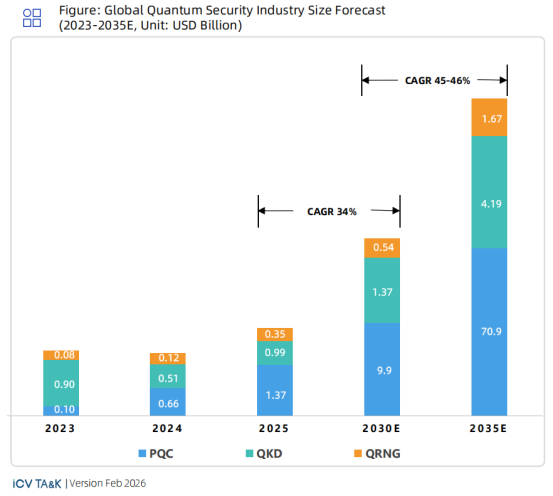
In 2025, the global quantum security industry size is approximately $2.703 billion, with a projected surge to $11.805 billion by 2030, representing a Compound Annual Growth Rate (CAGR) of roughly 34% for the 2025–2030 period. As the synergistic application of PQC and QKD establishes a stable deployment model, the industry is poised for accelerated growth after 2030. It is estimated that the industry size will reach approximately $76.795 billion by 2035, with the CAGR for the 2030–2035 period climbing to 45%–46%.

7. Ecosystem Collaboration Accelerates Systematic Development
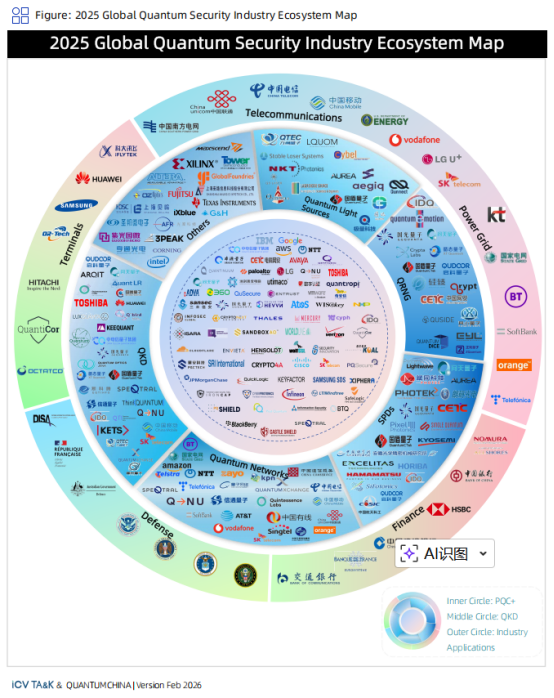
As quantum security technologies are validated across more real-world scenarios, the focal point of development is progressively shifting toward systemic ecosystem issues. Stakeholders are exhibiting a more diversified distribution, with clear division of labor emerging in capability supply, system embedding, and application implementation.
In sectors such as finance, government affairs, energy, and telecommunications, quantum security capabilities are being integrated into holistic security planning, advancing in synchronization with system upgrades and security policy updates. The focal point has shifted from the adoption of new technologies to achieving seamless interoperability and continuous operation within existing frameworks.
Outlook: The Path to 2035
Looking ahead, as quantum computing capabilities continue to advance and risks to traditional public-key cryptosystems are incorporated into long-term assessment frameworks, quantum security will evolve from phased deployment toward large-scale systematic implementation. The migration pace of PQC and the networking capacity building of QKD will form a layered and coordinated architecture, with hybrid security frameworks emerging as a pragmatic pathway.
Industry growth will be closely tied to the pace of national institutional advancements, infrastructure upgrade cycles, and sector-specific migration demands. Over a longer horizon, quantum security will reshape the architecture of global digital security.
The global quantum security industry is at a pivotal juncture, transitioning from small-scale validation to widespread application. In the short term, the focus remains on capability refinement and roadmap exploration; in the mid-to-long term, as quantum risks become manifest, quantum security is expected to be rapidly integrated into broader digital systems, laying a robust foundation for sustained market expansion.
Document Information
| Item | Details |
|---|---|
| Publisher | ICV TA&K |
| Report Version | Feb 2026 |
| Official Website | https://www.icvtank.com |
| Disclaimer | This document is derived from the full evaluation report. For raw data and detailed methodology, visit the official website. |
Report Link:2026 Global Quantum Security Industry Development Outlook
Contact details
Email: infer@icvtank.com


